Friday, September 27, 2013

Indiana State Fair 2013

 Indiana State Fair Entries... 

from most of the 92 Indiana County Champions


[Click on photo to get a larger image.]

Above is a picture of about 1/3 of the state fair insect collections for the 4-H Entomology Project that are entered from across the state.

To the left is the 2013 Grand Champion for the 4-H Entomology Exhibits.  As a former 4-H member, I collected and displayed insects in display boxes like these, but my exhibits never made it from the county to the state fair.  It is very difficult to collect enough orders of insects, properly preserve & display them, and properly identify each one.
[Click on photo to get a larger image.]


This Champion Exhibit was excellent!

- Photographed and submitted by John G. West

Friday, September 20, 2013

Preparation to Solve Problems

GETTING READY!

Before we leave to do a job at your house, the ACCA Basement/Crawl Space professional team prepares for the job by loading up all of the equipment, tools, and materials needed.


 PJ carrying out Clean Space products.


TJ loading equipment and materials onto the truck..


Shoveling gravel into buckets to load onto the truck.  Crawl spaces require the gravel and some other materials to be dragged under your house to where it is needed.


Josh is loading up gravel for a big job!


When all is ready, the team goes to your home to solve your moisture problem.  The work can be hard, but when the job is done, the team can look back on it with pride and satisfaction knowing they helped someone with a serious problem!

Thursday, September 12, 2013

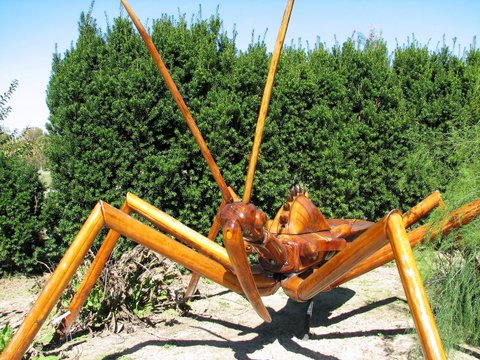
David Rogers' Big Bugs Sculpture Exhibition


Western Kentucky Botanical Gardens
Owensboro, KY
David Rogers' Big Bug Display


The Western Kentucky Botanical Garden is in Owensboro, Kentucky. Its 9 acres are open to the public year round. The entrance is just west of downtown on 2nd Street at Carter Road.

If you find bugs like this one in your back yard, 

call the ACCA Pest Control Professionals:
 
812-479-8905 or 800-477-7340


The Western Kentucky Botanical Garden Presents the
David Rogers' Big Bugs Sculpture Exhibition
September 12st thru October 30th 2013
WESTERN KENTUCKY BOTANICAL GARDEN
25 Carter Road  Owensboro, KY 42301
270-852-8925    wkbg@bellsouth.net wkbg.org
David Rogers is an outstanding artist from Long Island, New York who first presented his Big Bugs at the Dallas Arboretum in 1994. Since that time the Big Bugs have appeared to rave reviews in all of the major botanical gardens and in other venues across the entire country. In 2008 their appearance in Owensboro represented the first visit to Kentucky and was a great success both for their artistic beauty and their educational opportunities.
There will be 11 sculptures representing nine different bugs. These sculptures are created by all natural woods representing unique shapes, colors and textures providing a special sense of life for these fabulous and very big Big Bugs.
The world of "bugs" represents a truly amazing story of the life of nature at its most wonderful, fanciful and ferocious. Observing these wonderful and beautiful works of art provide a great opportunity for education which is a major goal of The Garden in presenting this exhibition. There will be programs provided during the Big Bugs stay for school children and adults to visit and learn all about the wonderful life of bugs in the natural setting of The Garden.
Garden Hours:  Seven Days a Week 9AM-3PM
Daily Admission applies*.
Members
Adults
Seniors
Youth
Free
$5.00
$3.00
$1.00

Thursday, September 5, 2013

The Family Owned Small Business


When you use a family owned business, you are not helping a CEO buy a third vacation home.

You are helping a little girl get dance lessons, a little boy get his team jersey, a mom or dad put food on the table, a family pay a mortgage, or a student pay for college.

Our customers are our shareholders and they are the ones we strive to make happy.

THANK YOU FOR SUPPORTING SMALL BUSINESS.

ACCA Waterproofing & Pest Control
Evansville, Indiana

812-479-8905          800-477-7340

Thursday, August 29, 2013

The Bookie Monster: attack of the creepy crawlies!


Bookie-Monster

The British Library's Collection Care Blog has an article that Dick Eastman suggests "should be required reading for anyone who cares for old books. The information applies equally to books at home or at a library, museum, or any other archive."  

While many articles have been published in this newsletter and elsewhere about the damage to books by fires, floods, hurricanes, tornadoes, and other disasters, the article by Christina Duffy describes a different threat that is equally damaging: insects!

If you take care of books, you should read The Bookie Monster: attack of the creepy crawlies! article at http://britishlibrary.typepad.co.uk/collectioncare/2013/08/the-bookie-monster-attack-of-the-creepy-crawlies.html.


The Bookie Monster: attack of the creepy crawlies!

[From the British Library's Collection Care Blog - - link above, also]

Have you ever been described as a bookworm?
We hope the only bookworms encountered in our reading rooms are of the Studious genus, but did you know that there are a whole host of pesky pests out there hungry for paper? Fires and floods are usually the scenarios we think of when we hear about damaged books, but books are also susceptible to pest damage. “Bookworm” is actually a generic term and doesn’t apply to any particular species, although it is often used to describe the Anobiid beetle (Anobium punctatum).
Furniture beetle damage
Figure 1: The larvae of furniture beetles, Anobium punctatum, attack wooden book boards, shelving, frames and compressed paper. Copyright DBP Entomology
Where the passionate reader sees inspiration and literary genius, the pest sees a delicious and satisfying papery meal. Holes in books and bindings, large chewed areas and scraped surfaces are all evidence of pest attack. Thankfully, damage like this is largely historic and it is a matter for conservation rather than pest control. Our Preservation Advisory Centre has produced a free information booklet on Managing pests in paper-based collections written by Consultant Entomologist David Pinniger. Although there are physical and chemical treatments to control infestation, it is much cheaper and far more effective to use preventive methods. Here we take a look at a few of the culprits.

Name: Silverfish (Lepisma saccharina)
Likes to eat: Paper

Silverfish (or fish moths) are nocturnal wingless scaly insects (10-15 mm) associated with damp conditions and require a localised humidity above 70-80%. They are named in light of their silvery exterior and slithery fish-like movements. 
Silverfish (Lepisma saccharina)

Figure 2: The silverfish is a primitive insect with three bristles called cerci at the tail end where the abdomen tapers. Copyright Aiwok
Post-meal evidence includes irregular holes in paper and ragged, scraped surface areas. If they are particularly greedy they will preferentially target areas with glue or ink which may be more nutritious.
Silverfish damage
Figure 3: Silverfish (sometimes known as fish moths) leave irregular holes in paper around a scuffed surface. Copyright DBP Entomology
[See link below for the complete article listing several other insect pests (with photos) - great article for saving great books!  This article was previewed on Dick Eastman's EOGN]
Pests will only usually damage material because they are seeking nutrition. Collection items boasting mouth-watering edible materials such as wooden boards, textiles, adhesives, gelatine and starch can satisfy the pickiest of pests. Prevention is always better than cure so it is important to be vigilant for the signs of an infestation. If you are unsure about a potential pest problem contact the Preservation Advisory Centre for some helpful advice.
Christina Duffy
- See more at: http://britishlibrary.typepad.co.uk/collectioncare/2013/08/the-bookie-monster-attack-of-the-creepy-crawlies.html

Thursday, August 15, 2013

Vaccinating Mosquitoes?


According to Debbie Hadley of About.com Guide:
Mosquitoes are the deadliest animals on Earth.
That's right, more deaths are associated with mosquitoes than any other animal on the planet. Mosquitoes may carry any number of deadly diseases, including malaria, dengue fever, yellow fever, and encephalitis. Mosquitoes also carry heartworm, which can be lethal to your dog.
 

   Vaccinating Mosquitoes Can Ward Off Malaria by Jesse Emspak in Popular Science Magazine September 2013 issue.  It’s not the mosquito’s fault.  Malaria is actually caused by the Plasmodium family of parasites, which is carried unwittingly by mosquitoes.  John Hopkins biologist Rhoel Dinglasan’s team has found this Plasmodium, at a critical stage in its life cycle, needs to bind to a particular protein in the mosquito.  Blocking this protein will block transmission to humans!  But, how do you treat a mosquito… with a tiny little needle?  Here is the clever solution: vaccinate humans against this protein creating living mosquito treatment factories for years by the immune systems producing antibodies against that protein.  Thus when a mosquito bites a vaccinated human, it will suck up the antibodies blocking the protein and thereby preventing the mosquito from passing along the malaria disease!!!  Of course, at this point, this remains only a hypothesis and mosquito bites would be no less annoying.


After my 25 years of Integrated Pest Management techniques and more traditional pest control practices, I think this vaccination idea is not so practical.  I suggest that we just get rid of the mosquitoes.

What Doesn't Work for Controlling Mosquitoes
Despite what your friends tell you, some popular mosquito control methods have no significant impact on keeping mosquitoes in check. According to Wayne J. Crans, Associate Research Professor in Entomology at Rutgers University, these often-touted mosquito solutions are not worth your time or money.
1.    Bug zappers. Though the satisfying sizzle you hear from this modern day insect torture device will convince you it's working, don't expect much relief from backyard mosquitoes. According to Crans, biting insects (including mosquitoes) generally make up less than 1% of the bugs zapped in these popular devices. Many beneficial insects, on the other hand, do get electrocuted.
2.    Citrosa plants. While citronella oil does have proven mosquito-repellent properties, the genetically-modified plants sold for this purpose do not. In tests by researchers, the test subjects bitten as often while surrounded by the Citrosa plants as without them. In fact, mosquitoes were observed landing on the leaves of Citrosa plants during the study.
3.    Bats and/or purple martins. While both bats and the colonial purple martins will consume mosquitoes, the offending insects make up a small percentage of their natural diet. Assertions about these insectivores being effective mosquito controls grew out of misrepresented and misinterpreted data from unrelated studies. While providing habitat for bats and purple martins has its value, don't do it if only to reduce your mosquito populations.
4.    Electronic devices that transmit sounds to mimic male mosquitoes or dragonflies do not work. Crans goes so far as to suggest "the claims made by distributors border on fraud." Enough said.

So, what can we do?

    1. If you want to keep  mosquitoes under control around your home, you  need to be vigilant about dumping any standing water  every few days.  Just a few inches of water is all it takes for a female to deposit her eggs. Tiny mosquito larva develop quickly in bird baths, roof gutters, thrash can lids, and old tires dumped in vacant lots.

    2. Avoid going outdoors between dust and dawn.

    3. Use mosquito repellents like DEET.
    4. Insecticides can be used to help control mosquitoes.  Some products are designed to be applied directly to water to control mosquito larvae, while others are used more broadly to control the adult mosquito.
    5. Community, city or county agencies provide control as a service to the public and may apply pesticides by trucks or planes.
 

Thursday, August 1, 2013

Cicadas: Are they Locusts or Katydids?

Order HOMOPTERA: 
Cicadas, Aphids, Leafhoppers


Cicadas are not Locust nor Katydids!

Cicadas are members of the order Homoptera and are physically distinguished by their stout bodies, broad heads, clear-membrane wings, and large compound eyes (see photo below).

Cicadas are recognized as the loudest animal in the world.  Cicadas are probably best known for their buzzing and clicking noises, which can be amplified by multitudes of insects into an overpowering hum. Males produce this species-specific noise with vibrating membranes on their abdomens.  I am sure most have heard the loud chirping of cicadas in the summer evenings, especially while driving in rural areas.  The "songs of cicadas" are like a child's lullaby to put one asleep during the night.  Cicadas can be heard as far as one mile away!

Cicadas are also famous for their penchant for disappearing entirely for many years, only to reappear in force at a regular interval. There are some 3,000 cicada species, but only some share this behavior (the 13-year and 17-year cicadas are examples).  The dog day cicada emerges each year in mid-summer.

Have you ever noticed the cicada "shell" or exoskeleton?  That shell is the outer exoskeleton of the final molt from the nymph stage to the adult.  

On the night of emergence, nymphs leave their burrows, locate a suitable spot on nearby vegetation (often tree bark), and complete their final molt to adulthood.


Adult Tibicen Cicadas

Tibicen


For more information on these amazing insects visit -  http://www.cicadamania.com/ and here is a long list of links to all kinds of sites you can visit including a link to a site about Cicada Killer Wasp, the mortal enemy of cicadas!  And here is a link to frequently asked questions (FAQ's) about cicadas -  http://www.cicadamania.com/faq.html .